
Clinical Readiness in 2026: Why Healthcare Communication Must Go Beyond Nurse Call

In healthcare, communication isn’t a convenience.
It’s clinical infrastructure.
A delayed code alert.
A missed patient assignment update.
An overhead page without context.
In a hospital environment, small communication gaps can create operational strain — and clinical risk.
As care models evolve, healthcare leaders are recognizing something important:
Traditional nurse call and paging systems are no longer enough.
Today’s hospitals need integrated clinical communication platforms that support real-time collaboration, workflow automation, and coordinated emergency response.
The Challenge: Disconnected Systems in a High-Stakes Environment
Many healthcare facilities still rely on layered, disconnected systems:
Nurse call platforms
Overhead paging
Mobile messaging apps
EHR dashboards
Access control
Surveillance
Each serves a purpose.
But when they operate independently, staff must bridge the gaps manually.
Manual updates slow response.
Verbal relays create miscommunication.
Fragmented alerts lead to uncertainty.
In high-acuity environments, clarity must be built into the system itself.
From Nurse Call to Clinical Communication Platform
Modern healthcare communication is shifting from reactive alerts to coordinated workflows.
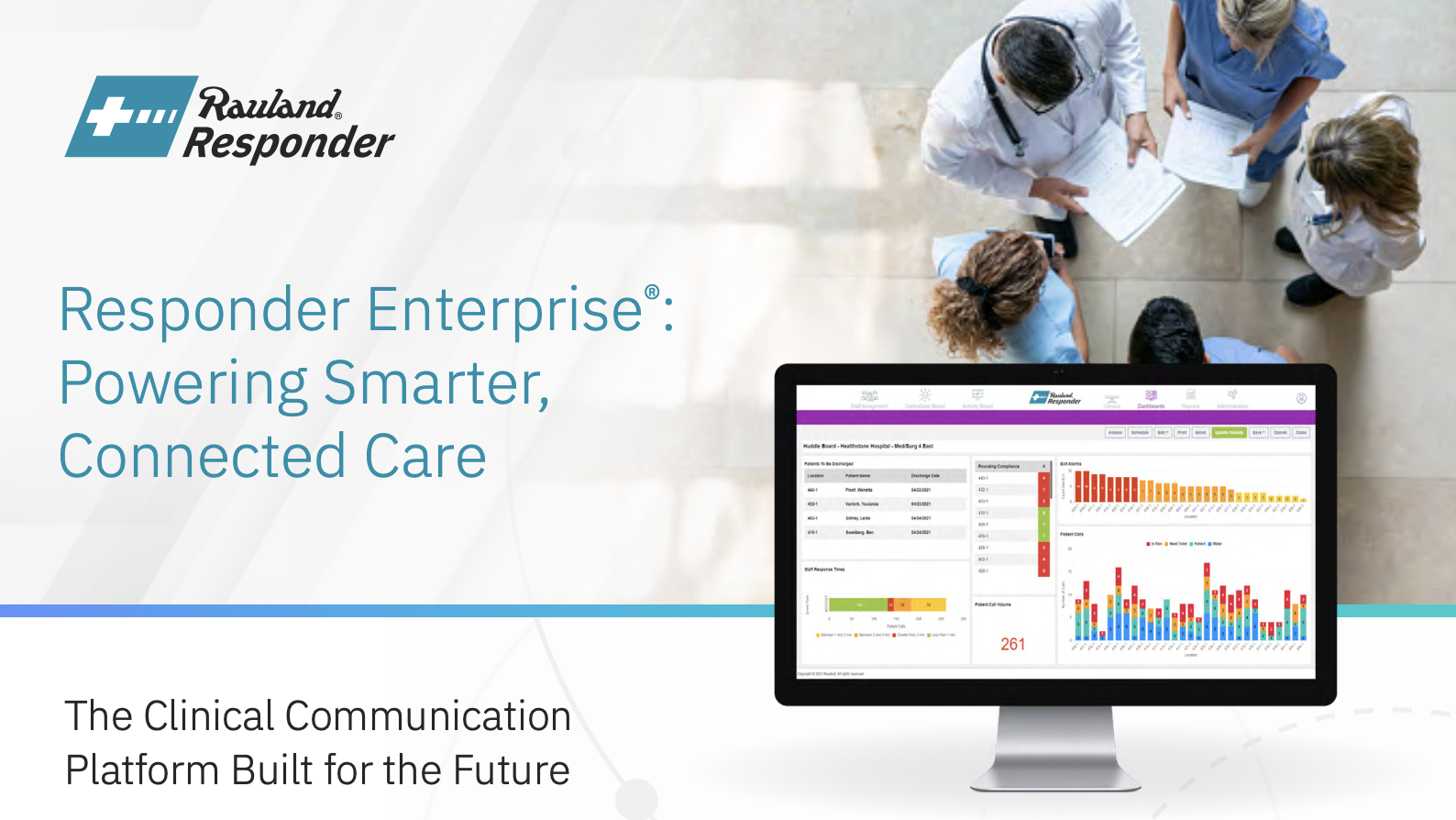
Rauland’s Responder Enterprise® was designed to support that shift — moving beyond basic call functionality to a unified clinical communication platform built for connected care .
Responder Enterprise enhances collaboration by integrating:
EHR staff assignment automation
Real-time status boards
Mobility tools
System-wide interoperability
Secure, scalable architecture
Instead of relying on separate systems to communicate patient updates, assignments, and code alerts, hospitals gain a centralized, intelligent communication environment.
This is clinical readiness.
Explore the Clinical Communication Platform in Detail
Responder Enterprise integrates clinical workflows, EHR staff assignments, emergency communication, and real-time visibility into one secure platform.
For a closer look at features, integrations, and architecture, download the full brochure.
Real-Time Visibility Supports Faster Decisions
One of the most powerful capabilities of Responder Enterprise is real-time visibility.
Status boards provide insight into:
Patient activity
Staff assignments
Care team locations
For nurse leaders and department heads, this creates immediate situational awareness.
When a patient’s condition changes, teams can see who is assigned and respond without delay.
When staffing shifts occur, updates are automated — reducing manual coordination.
When seconds matter, visibility matters.
Emergency Communication Must Be Unified
Clinical workflows and emergency response cannot operate in silos.
Responder Enterprise integrates with Telecenter® functionality to enable unified overhead paging of code and urgent calls — supporting immediate, coordinated emergency response .
This integration allows facilities to:
Initiate code alerts instantly
Distribute urgent overhead announcements
Coordinate response teams
Align clinical and security communication
Instead of separate emergency and clinical systems, hospitals operate from one connected framework.
Secure, Scalable, and Built for Growth
Healthcare technology decisions must support long-term strategy.
Responder Enterprise is built on a modern, secure architecture designed for enterprise-grade reliability and scalability .
It integrates with:
Smart beds
EHR systems
RTLS platforms
Virtual nursing
Mobile devices
This level of interoperability ensures communication evolves alongside clinical innovation — not behind it.
Supporting Care Teams in a High-Pressure Environment
Healthcare professionals work in environments defined by urgency.
Technology should reduce friction, not add to it.
An integrated clinical communication platform:
Reduces manual tasks
Standardizes workflows
Improves assignment accuracy
Strengthens code coordination
Provides actionable analytics for performance improvement
When communication systems are aligned with clinical workflows, staff operate with greater confidence — and patients benefit.
Evaluating Your Clinical Communication Strategy
If your facility is reviewing its communication infrastructure, consider asking:
Are our nurse call and paging systems integrated with clinical workflows?
Do we have real-time visibility into staff assignments?
Can we initiate and coordinate code events instantly?
Are our systems secure and scalable for future growth?
Are we relying on manual processes that create delay?
In 2026, communication is not just a facilities concern.
It is a clinical one.
At Communication Company, we work alongside healthcare leaders to assess current systems and design integrated communication strategies that support both patient care and operational excellence.
Because in healthcare, when seconds matter, coordination matters even more.
Ready to Modernize Your Clinical Communication Strategy?

Today’s healthcare environments demand more than basic nurse call and overhead paging. They require integrated platforms that support clinical workflows, emergency response, and real-time visibility.
If you’re evaluating how communication impacts patient care, staff coordination, and operational efficiency, our team is here to help.
Contact our Healthcare Account Manager, Lynnetta Cleary, today.
